Korean matcha snacks: why the trend goes beyond lattes
MEOKBOGO ORIGINAL · FOOD CULTURE
Looking for matcha in Korea? Start in the snack aisle. The green-tea boom is turning up in brownies, wafers and rice cakes—not just lattes.
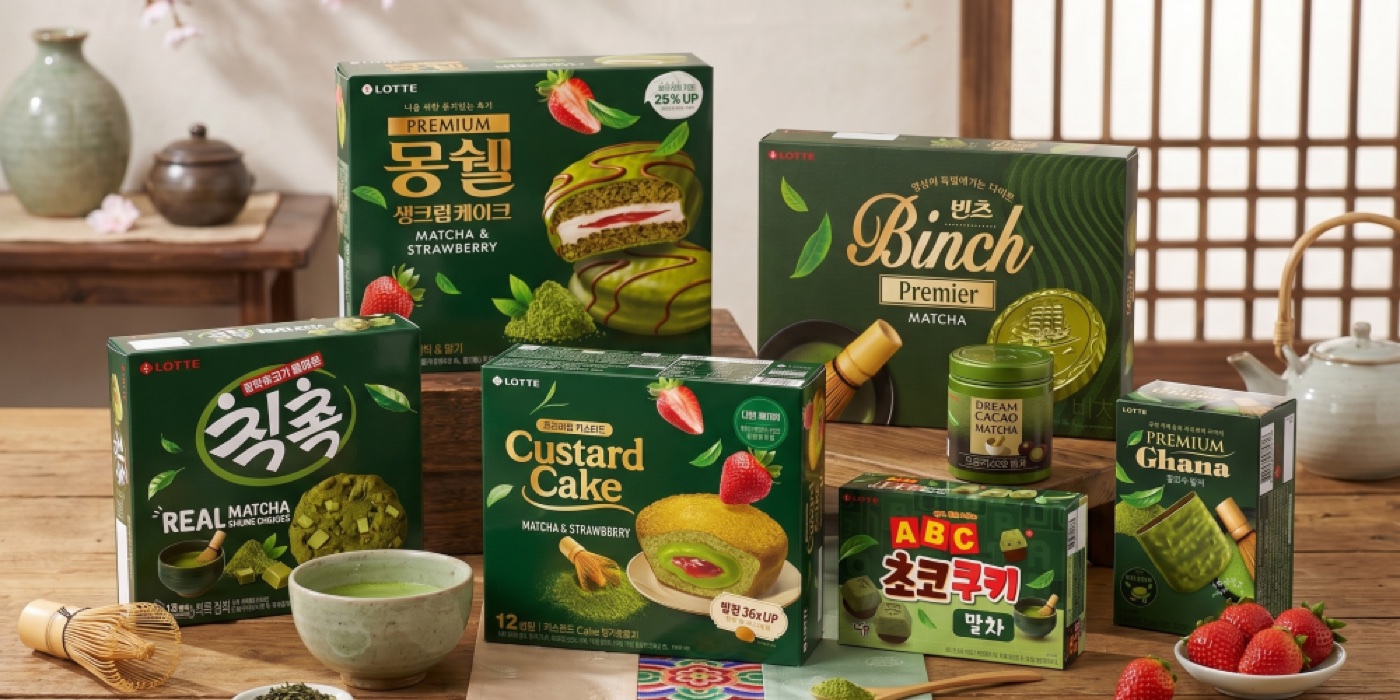
Korean convenience-store shelves are getting greener. Matcha now appears in brownies, wafers, chocolate, langue de chat cookies and even protein bars. In a September 11, 2026 snapshot of the Meokbogo product catalog, 39 Korean products had matcha in their names. Thirty were snacks, baked goods or rice cakes. Only three were drinks.
For a visitor following the matcha trend, that changes where to look. The powder that much of the world is stirring into a cup is also finding its way into Korea's snack aisle.
Matcha is something to eat here, too
The catalog snapshot breaks down like this:
| Category | Products |
|---|---|
| Snacks, baked goods and rice cakes | 30 |
| Frozen desserts | 4 |
| Drinks | 3 |
| Dairy products | 2 |
| Total | 39 |
Source: Meokbogo catalog, September 11, 2026. This is a catalog snapshot, not a count of every matcha product sold in Korea or a guarantee of stock at an individual store.
Korean confectioners helped fill those shelves. According to Food & Beverage News, Orion, Lotte Wellfood and Haitai introduced 16 matcha products between them in 2025. The idea even reached savory food: CJ CheilJedang said its Instagram content featuring matcha cabbage kimchi and matcha dumplings drew 8.5 million views and 400,000 interactions. Those figures describe the response to content, not retail sales.
The drinks story is more complicated
Not every matcha menu expanded. A Twosome Place discontinued its iced matcha and strawberry matcha drinks in late 2025. News1 reported that demand for Jeju-grown matcha had risen to three or four times its previous level, while supply met only 30–40% of demand.
The industry has not established that the rise in matcha snacks and the withdrawal of those drinks had a single shared cause. Both happened in the same year.
Behind the green shelves: a global powder boom
Japan's green-tea exports reached a record 72.1 billion yen and 12,612 metric tons in calendar year 2025, according to Japan's Ministry of Agriculture, Forestry and Fisheries. Powdered tea, including matcha, accounted for 69.1% of export volume and 83.8% of value. The United States took 35% of the total export volume.
US demand was rising too. AP reported in September 2025 that NIQ data showed an 86% increase in US retail matcha sales over three years. Starbucks said tea sales at its US company-operated stores grew by more than 70% between fiscal 2021 and 2025, and that its year-round matcha drink lineup had tripled from four drinks in 2023 by February 2026.
Kyoto tea sellers began limiting purchases in autumn 2024. Marukyu Koyamaen capped purchases at two tins per person at five directly operated stores in November; Ippodo had introduced limits in stores and online in October. Marukyu Koyamaen explained that it buys its tea raw material at a particular time each year. A sudden jump in demand cannot instantly create another harvest.
The fields are changing what they grow
Tencha—the tea used to make matcha—was not simply disappearing. Japanese production reached 6,278 metric tons in 2025, about 3.2 times the 1,969 tons recorded in 2014.
Other tea categories moved in the opposite direction. Japan's first-harvest tea production fell from 40,682 tons in 2008 to 25,213 tons in 2025, a decline of about 38%. Kyoto's tencha-growing area reached 717.1 hectares in 2025, up 20.7% from the previous year, while its sencha-growing area fell 35.4% to 224.8 hectares.
Prices show the pressure. The average first-harvest tencha trading price at the Zen-Noh Kyoto tea market rose from 4,121 yen per kilogram in 2022 to 14,144 yen in 2025 and 17,797 yen in 2026. These are wholesale trading prices, not prices for tins on a shop shelf.
Increasing supply takes time. Kyoto's tea industry chamber says tea takes around five to six years from planting to harvest. Japan also lost many tea-growing businesses: the agricultural census counted 53,687 in 2000 and 12,325 in 2020.
What to look for on your Korea trip
Give the snack and dessert shelves a look as well as the cafe menu. Brownies, wafers, chocolate and rice cakes are part of Korea's matcha story. Product availability changes, so treat this as a guide to the trend rather than a shopping list with guaranteed stock.
A green wrapper is a starting point for discovery. The ingredient list is where you check what the individual product actually contains.
Comments
Post a Comment