Bichobi explained: Korea's biscuit-chocolate-biscuit, and the strawberry one
Bichobi is the Korean biscuit that keeps ending up in tourists' suitcases. Here is what it actually is, what is inside it, and why the strawberry version is the one worth hunting for.
If you have walked through a convenience store in Seoul in the last three years, you have passed a red box with a cartoon character on it. That is Bichobi (Korean: 비쵸비), made by Orion. It arrived in October 2022, sold out repeatedly, and has since turned into one of the snacks foreign visitors carry home by the boxful.

The name tells you the recipe
"Bichobi" is not a word in Korean. It is an abbreviation of the three layers of the snack: Biscuit – Chocolate – Biscuit. Two whole-wheat biscuits, and between them a slab of solid chocolate rather than a cream filling. The chocolate carries hazelnut, which is where the roasted, slightly savoury edge comes from.
That structure is the whole point. Most chocolate sandwich biscuits in a Korean convenience store use a soft cream. Bichobi uses a bar. You bite through a crisp layer, hit something that snaps, and then hit crisp again. Koreans describe the texture rather than the flavour when they recommend it, and that is a fair guide to what you are buying.
It was a hit in Korea long before tourists found it
The order matters, because it explains what you are actually buying. Bichobi was not designed as a souvenir. It went on sale in Korean convenience stores in October 2022 and became a domestic hit fast — fast enough that Orion could not keep up, and the product went missing from shelves. Korean coverage at the time put that down to younger shoppers, who took to the texture and passed it around.
Foreign visitors arrived at the story years later. The tourist surge shows up in Orion's own numbers only from 2024, and exports only from 2026. So when a Korean recommends this to you, they are not recommending a tourist product. They are recommending something that was already in their own bag.
You can still see the domestic pattern in where it sells. Orion's top ten selling locations now read like a transit map — Seoul Station, Jagalchi Market in Busan, Seokchon Lake in Jamsil, Gimpo and Incheon airports, Jeju. Those are places Koreans and visitors pass through together.
How big has this actually become
The numbers come from Orion's own announcements, reported in the Korean business press:
- Launched October 2022. Supply ran short soon after release.
- 17 million units cumulative by September 2024, with sales up 62% year on year for January–August 2024.
- In tourist-heavy areas such as Seoul Station and Myeongdong, sales rose 360% over the same period — roughly six times the nationwide rate.
- By April 2026, cumulative volume reached 33 million units and cumulative revenue 55 billion won.
- Orion doubled the production line at its Iksan plant in April 2026, citing shortages and rising exports to the United States and Japan.
- For January–August 2026, sales rose a further 53% year on year.
- It is going into 37 Costco stores in Japan from October 2026, with Costco in the United States planned for early 2027 — the point at which you will no longer need a trip to Korea to buy it.
Orion has said that posts about Bichobi in English, Chinese and Japanese tend to frame it the same way: good-looking packaging, easy to hand over as a gift. The company leaned into that, releasing packs illustrated with figures in traditional Korean dress for stores in visitor districts.
There is a second signal that does not come from the company. Bichobi is now listed by third-party sellers on Amazon and eBay under several spellings — Bichobi, Vichobi, Bischobi — which is usually what happens when demand runs ahead of official distribution. If you are searching for it from outside Korea, try more than one spelling.
The strawberry one is the one to look for
For almost three years Bichobi came in exactly one flavour. That changed on 4 September 2025, when Orion released Bichobi Strawberry as a limited edition — the first new flavour in the line.
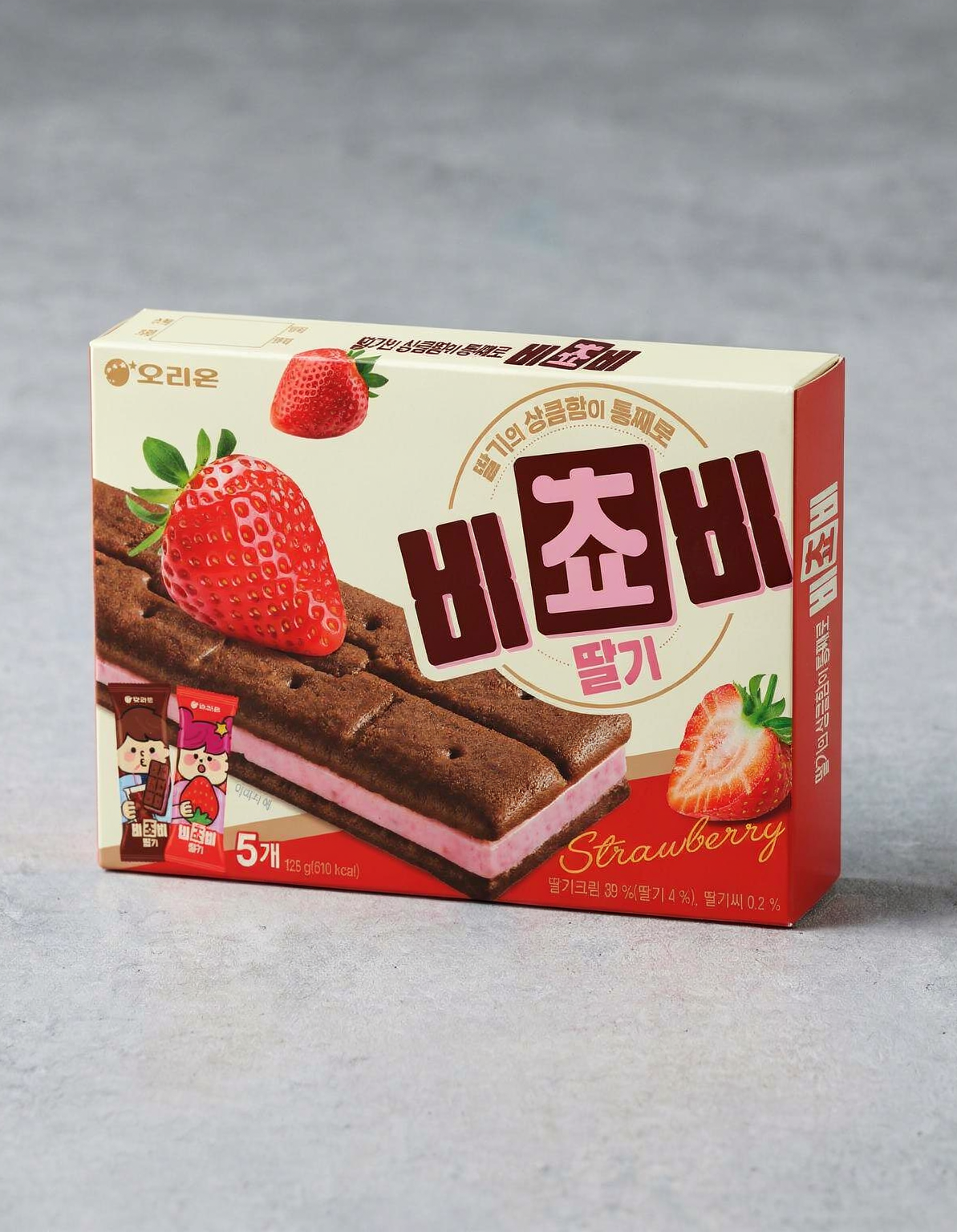
It is built differently from the original. Instead of milk chocolate between wheat biscuits, it puts a strawberry chocolate slab between cocoa biscuits, and the slab carries real strawberry seeds. The seeds are not decoration; they pop slightly against the cocoa, which is what people describe when they say it tastes closer to fruit than to candy.
It was popular enough that Orion made it permanent in April 2026 after repeated requests, and raised the cocoa content to 1.4 times the original level so the chocolate would hold its own against the fruit. So the strawberry version you find now is not the same recipe as the 2025 limited run — it is a darker one.
A third flavour, matcha chocolat, also exists on Korean shelves.
What is actually inside
All figures below are per 100 g, taken from each product's nutrition label as filed with Korea's Ministry of Food and Drug Safety (MFDS). Per-100 g is the only way to compare these fairly.
| Product | Calories | Sodium | Sugar | Protein | Fat | Carbs |
|---|---|---|---|---|---|---|
| Bichobi 비쵸비 | 504 kcal | 220 mg | 40 g | 8 g | 24 g | 64 g |
| Bichobi Strawberry 비쵸비 딸기 | 504 kcal | 280 mg | 36 g | 4 g | 24 g | 68 g |
| Bichobi Matcha Chocolat 비쵸비 말차쇼콜라맛 | 524 kcal | 380 mg | 37 g | 6 g | 26 g | 66 g |
Two things stand out. The strawberry version is not the sweeter one — it carries less sugar than the original and more carbohydrate, which fits a fruit-flavoured chocolate over a cocoa biscuit. And the matcha version is the heaviest of the three on calories, sodium and fat.
Ingredient notes on the original label include wheat, milk chocolate, butter oil, fermented milk and peanut or tree-nut processed products. If you avoid nuts, that last one matters: the hazelnut is not a garnish, it is in the chocolate. Anything not written on a label is simply not recorded, and a label does not rule out shared production lines.
If you are buying it as a gift
A box holds five individually wrapped pieces, each wrapper printed with a different character, which is most of the reason it reads as a souvenir rather than as a snack. The wrappers are the gift; the biscuit is what happens afterwards.
What is stocked changes by store and by season, and the strawberry version moves faster than the original in visitor districts. If you see it, that is the moment.
Nutrition figures come from product labels as filed with Korea's Ministry of Food and Drug Safety (MFDS). Company figures and launch dates from Orion announcements as reported by Businesskorea (5 September 2024), Hankyung (13 April 2026) and Asia Economy (10 September 2026). Product photography: Meokbogo archive and Orion (orionworld.com).
Comments
Post a Comment